Technology has become an essential part of running a successful business. From managing customer information to preparing invoices, tracking sales, and communicating with clients, businesses rely on different software applications to make their daily operations easier.
However, the rapid growth of artificial intelligence (AI) has introduced a new question for business owners: Should we continue using traditional software, or is it time to embrace AI-powered solutions?
For many small and medium-sized businesses, especially those operating in Nigeria and other developing markets, choosing the right technology can make a significant difference in productivity, operating costs, and customer satisfaction.
Traditional software has helped businesses operate efficiently for decades. AI, on the other hand, introduces capabilities that allow computer systems to recognise patterns, generate content, analyse information, and assist with decisions in ways that conventional applications may not.
But does this mean AI is better than traditional software?
Not necessarily.
Both technologies have their strengths, limitations, and appropriate uses. Understanding these differences can help business owners make informed decisions without spending money on tools they do not actually need.
In this article, we will explain the differences between AI and traditional software, explore their practical applications, and discuss what businesses should consider before investing in either technology.
 What Is Traditional Software?
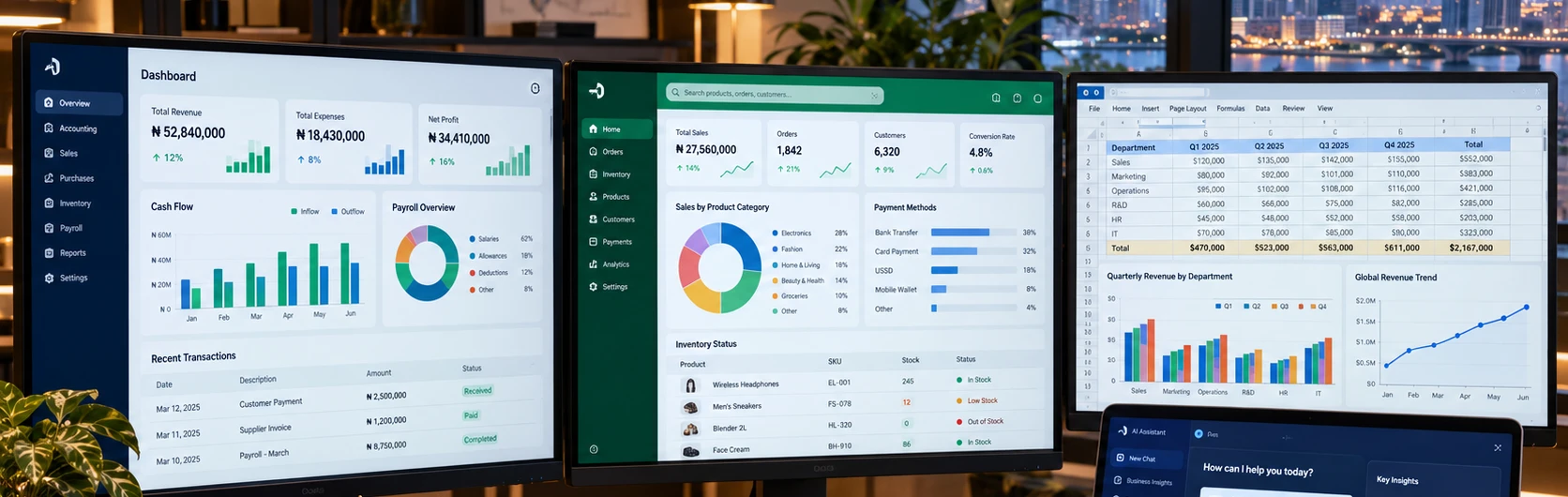 What Is Traditional Software?
Traditional software refers to computer programs designed to perform tasks according to predefined instructions, rules, and processes.
These programs generally operate based on functions developed by programmers. When a user performs an action, the software follows its programmed logic to produce a result.
For example, an accounting application can calculate the total amount on an invoice by multiplying quantities by prices and adding applicable taxes.
A payroll system can calculate employee salaries based on predefined formulas and deductions.
A point-of-sale (POS) application can record transactions, update stock quantities, and generate sales reports.
These are examples of tasks that traditional software handles effectively.
Common Examples of Traditional Software
Traditional software is widely used in business operations, including:
- Accounting software: Used for bookkeeping, invoicing, and financial reporting.
- Inventory management systems: Help businesses monitor stock levels and product movement.
- Payroll applications: Calculate salaries, allowances, and deductions.
- Customer relationship management (CRM) systems: Store customer information and track interactions.
- Spreadsheet applications: Organise data, perform calculations, and prepare reports.
- Point-of-sale systems: Process transactions and maintain sales records.
Many modern versions of these applications now include AI features, but their core functions can still operate through conventional programming.
Traditional software remains valuable because it provides consistency, structured workflows, and predictable results.
What Is Artificial Intelligence Software?
Artificial intelligence software uses computational techniques that enable systems to perform tasks commonly associated with human intelligence.
These tasks may include understanding language, recognising images, identifying patterns, generating content, making predictions, and recommending actions.
Unlike conventional software that relies primarily on explicitly programmed rules, many AI systems learn statistical patterns from data during training.
For example, an AI-powered customer service tool may analyse a customer’s question and generate a relevant response.
An AI writing assistant can help prepare a business proposal, email, or marketing message based on the user’s instructions.
An AI-powered analytics system may examine historical sales records and identify patterns that could help a business plan future inventory requirements.
However, AI systems do not always produce correct results. Their outputs may depend on training data, system design, and the quality of information provided.
This is why human review remains important, particularly when AI is used for business decisions.
 Common Examples of AI Software
 Common Examples of AI Software
Businesses increasingly use AI for:
- Drafting business emails and marketing content.
- Answering frequently asked customer questions.
- Analysing sales trends and customer behaviour.
- Identifying unusual transactions.
- Summarising documents and reports.
- Supporting recruitment and administrative processes.
- Predicting product demand.
- Assisting with website content creation.
AI is especially useful when a task involves large amounts of information, language processing, or patterns that are difficult to describe using simple rules.
AI vs Traditional Software: Understanding the Key Differences
Although AI and traditional software can perform similar business functions, they often approach tasks differently.
The following comparison highlights some important distinctions.
| Feature | Traditional Software | AI Software |
|---|---|---|
| How it works | Uses predefined rules and programmed logic | Often uses trained models and statistical patterns |
| Flexibility | Usually operates within defined functions | Can adapt its responses to varied inputs |
| Output | Often predictable for the same inputs | May produce different responses to similar inputs |
| Data processing | Processes data according to programmed instructions | Can identify complex patterns in data |
| Content creation | Usually relies on templates and fixed workflows | Can generate new text, images, and other content |
| Accuracy | Reliable when rules and input data are correct | Can be useful but may generate incorrect results |
| Human supervision | Needed for setup, exceptions, and oversight | Often needed to verify outputs and manage risks |
| Best suited for | Structured, repeatable business processes | Language tasks, pattern recognition, and complex analysis |
It is important to understand that these categories are not completely separate.
A modern business application may combine traditional programming with AI capabilities to deliver a more complete solution.
For instance, an accounting platform might use conventional calculations to prepare financial statements while using AI to identify unusual spending patterns.
1. AI Offers Flexibility, While Traditional Software Provides Predictability
One of the biggest differences between AI and traditional software is how they respond to different situations.
Traditional software is generally designed to follow established procedures.
For example, when a customer purchases three products from an online store, the checkout system calculates the total using predefined prices, quantities, taxes, and delivery charges.
The same valid inputs should normally produce the same calculation.
AI systems can handle less structured requests.
Imagine a customer asking an online store:
I need a reliable laptop for office work, online meetings, and occasional graphic design. What should I buy?
An AI-powered assistant may interpret the customer’s requirements and recommend suitable product categories or options.
However, those recommendations still need accurate product information, pricing, and availability.
What this means for businesses: Use traditional software for tasks that require consistent calculations and clearly defined processes. Consider AI for situations that require interpreting language, analysing patterns, or generating recommendations.
2. Traditional Software Is Often Better for Critical Calculations
Accuracy is extremely important in business.
An incorrect invoice, salary calculation, or tax computation can create serious problems.
Traditional software is usually more appropriate for calculations that must follow exact formulas and established business rules.
For example, a payroll application can calculate salaries using approved employee records, salary structures, and statutory deductions.
AI may assist by explaining payroll reports or helping identify unusual entries, but it should not be treated as an unquestionable source for financial calculations.
Generative AI systems can make arithmetic mistakes or produce plausible-looking but incorrect figures.
Businesses should therefore use properly tested accounting and payroll systems for critical calculations, while applying AI as a supporting tool where appropriate.
3. AI Can Improve Customer Service
Customer service is one area where AI can provide noticeable benefits.
Traditional customer service systems may use predefined responses and menu options.
For example, a customer contacting an online business might receive these options:
Press 1 for product enquiries.
Press 2 for delivery information.
Press 3 for payment support.
These systems can work well for straightforward enquiries, but they may struggle when customers ask questions outside the available options.
AI-powered customer service tools can interpret a wider variety of questions and generate more conversational responses.
A customer might ask:
I placed an order yesterday, but I entered the wrong delivery address. Can I change it?
An AI assistant connected to an approved order management system could identify the relevant policy and guide the customer through the available options.
However, businesses must ensure that AI assistants do not invent policies, promise unavailable services, or disclose confidential customer information.
For complicated complaints or sensitive issues, customers should have access to a human support representative.
4. AI Can Help Businesses Save Time on Administrative Work
Administrative tasks can consume a significant portion of the working day.
Business owners often spend time preparing emails, organising documents, writing reports, and responding to routine enquiries.
AI tools can assist with many of these activities.
For example, a small business owner who needs to send a professional quotation follow-up email can use an AI writing assistant to prepare a draft within seconds.
Instead of starting from a blank page, the owner can review and personalise the message.
Similarly, AI can summarise lengthy meeting notes, suggest report structures, and help organise unstructured information.
Traditional software also saves time, particularly through automated workflows, templates, and scheduled processes.
The difference is that AI can often assist with tasks that require interpreting or generating natural language.
The best approach is to identify repetitive tasks and choose the technology that handles them most reliably.
5. AI and Traditional Software Have Different Cost Considerations
Many business owners assume that AI is automatically more expensive than traditional software.
In reality, costs depend on the application, provider, usage, and implementation requirements.
Traditional software may involve:
- One-time licence fees or recurring subscriptions.
- Installation and configuration costs.
- Staff training.
- Maintenance and technical support.
- Upgrades and integration expenses.
AI solutions may involve similar costs, alongside additional expenses for model usage, data processing, monitoring, and quality control.
For example, a business using an AI chatbot may pay a monthly subscription or usage-based fees depending on the number of customer interactions.
An existing spreadsheet application, on the other hand, may already meet the business’s reporting needs without requiring a separate AI subscription.
Before purchasing any software, businesses should consider the total cost of ownership rather than focusing only on the advertised subscription price.
A tool is valuable when the benefits justify its cost.
6. AI Can Support Better Business Analysis
Businesses generate information through sales, customer interactions, inventory movements, and financial transactions.
Making sense of this information can help business owners identify opportunities and potential problems.
Traditional reporting software can organise records and produce charts, tables, and financial summaries.
AI-powered analytical tools can go further by identifying patterns, generating explanations, and assisting with predictions.
For example, a retail business may use AI to examine previous sales records and estimate demand for certain products during festive periods.
This could help management make better inventory decisions.
However, AI predictions are not guarantees.
Changes in customer behaviour, economic conditions, product availability, and market competition can affect actual results.
Business owners should treat AI-generated forecasts as supporting information rather than unquestionable facts.
7. Security and Privacy Matter for Both Technologies
Every business that uses digital tools should take cybersecurity seriously.
Traditional software can face risks such as unauthorised access, malware, weak passwords, and outdated security patches.
AI-powered systems may face additional risks, including the accidental exposure of confidential information, misleading generated content, and attacks designed to manipulate AI responses.
For example, an employee might unknowingly paste confidential customer records into an AI tool that has not been approved for handling sensitive business information.
This could create privacy and compliance concerns.
Businesses should establish clear guidelines covering:
- Which software employees are authorised to use.
- What information can be entered into AI tools.
- How customer records are stored and protected.
- Who can access sensitive business information.
- How software updates and security patches are managed.
- When human approval is required before an AI-generated action is taken.
For Nigerian businesses, the Nigeria Data Protection Act 2023 is an important consideration when processing personal data.
Businesses should assess their legal obligations and choose software providers with appropriate privacy and security safeguards.
8. AI Does Not Automatically Replace Employees
The introduction of AI has created concerns about the future of work.
Some business owners see AI as an opportunity to reduce repetitive tasks, while employees may worry that automation could replace their roles.
The reality is more complex.
AI can automate or assist with certain activities, but many business functions still require human experience, accountability, creativity, and judgement.
For example, AI can draft a customer complaint response, but a customer service manager may still need to investigate the problem and approve a suitable resolution.
AI can generate a business proposal, but the business owner must confirm that the proposed services, prices, and commitments are accurate.
Rather than viewing AI purely as a replacement for employees, businesses can explore how it can support staff productivity.
Training employees to use appropriate AI tools responsibly may help them spend more time on customer relationships, problem-solving, and other valuable activities.
9. Small Businesses Can Benefit From Both Technologies
Consider a small website design and digital services company operating in Warri, Delta State.
The company manages client enquiries, prepares quotations, develops websites, tracks project payments, and provides technical support.
Traditional software might be used for:
- Recording customer payments.
- Managing invoices and expenses.
- Tracking project deadlines.
- Storing client information.
- Maintaining website hosting accounts.
AI tools could assist with:
- Drafting professional client emails.
- Preparing website content outlines.
- Generating initial marketing ideas.
- Summarising customer requirements.
- Creating first drafts of technical documentation.
- Identifying common customer support questions.
The business does not need to abandon its existing systems to benefit from AI.
Instead, it can introduce AI where it provides measurable improvements.
This approach is often more practical than replacing reliable software simply because a newer technology is available.
10. How to Decide Whether Your Business Needs AI
Before investing in an AI-powered application, it is important to understand the actual problem you want to solve.
Start by examining your current business operations.
Are employees spending too much time answering similar customer questions?
Are reports taking longer than necessary to prepare?
Do you struggle to organise information from multiple sources?
Or do you simply need a reliable accounting application to manage daily transactions?
Not every challenge requires AI.
A conventional application may provide a simpler and more affordable solution.
When evaluating a new tool, consider the following questions:
What problem will the software solve?
Identify the specific task or operational challenge.
Can existing software handle the task?
Review the features of applications you already use before purchasing something new.
How accurate must the results be?
Tasks involving financial calculations, legal obligations, and sensitive information may require strict controls and human verification.
What will the software cost?
Consider subscriptions, setup, training, integration, and ongoing maintenance.
Will employees be able to use it effectively?
A powerful tool may deliver little value if staff members do not understand how to use it.
How will success be measured?
Set practical indicators such as reduced processing time, fewer errors, faster customer responses, or lower operating costs.
These questions can help businesses avoid unnecessary technology expenses.
11. A Practical Approach to Introducing AI Into Your Business
Businesses do not need to introduce AI across every department at once.
A gradual approach allows management to evaluate the benefits while controlling costs and risks.
Step 1: Identify a Repetitive Task
Choose an activity that consumes time but does not involve highly sensitive decisions.
For example, preparing routine customer follow-up emails may be a suitable starting point.
Step 2: Select an Appropriate Tool
Compare available tools based on their features, pricing, privacy practices, and compatibility with your existing systems.
Step 3: Run a Small Trial
Allow a limited number of employees to use the tool for a defined period.
Compare the results with your previous process.
Step 4: Review the Output
Check whether the tool improves efficiency without introducing unacceptable errors or privacy risks.
Step 5: Train Employees
Explain how the software should be used, what information can be shared, and when human approval is necessary.
Step 6: Expand Gradually
If the trial produces useful results, consider introducing the technology into other suitable areas of the business.
This measured approach helps businesses adopt technology based on evidence rather than excitement.
12. The Future of AI and Traditional Business Software
The future of business technology is unlikely to be a simple competition between AI and traditional software.
Instead, the two are increasingly being combined.
Accounting applications may include AI-assisted financial analysis.
Customer relationship management systems may offer AI-generated summaries of customer interactions.
Website management platforms may introduce AI tools for content creation, customer support, and technical assistance.
Inventory applications may combine conventional stock records with AI-supported demand forecasting.
These developments suggest that businesses will increasingly use software that combines structured programming with intelligent assistance.
However, successful adoption will still depend on factors such as affordability, data quality, cybersecurity, staff training, and responsible management.
Businesses that understand both the opportunities and limitations of AI will be better positioned to make sensible technology decisions.
Frequently Asked Questions
What is the main difference between AI and traditional software?
Traditional software generally follows predefined programming rules, while many AI systems use trained models to recognise patterns, interpret information, and generate responses. Modern applications can combine both approaches.
Is AI better than traditional software for businesses?
Not always. AI may be more useful for tasks involving language, pattern recognition, and complex data analysis. Traditional software is often preferable for structured workflows and exact calculations.
Can AI replace traditional business software?
AI can replace or automate some individual functions, but businesses still need reliable systems for accounting, recordkeeping, transactions, and other structured operations. Many AI solutions work best alongside existing software.
Is AI expensive for small businesses?
AI costs vary. Some services provide free or low-cost access, while advanced business solutions may require subscriptions, usage fees, integration, and staff training. Businesses should compare costs against measurable benefits.
Can small businesses in Nigeria use AI?
Yes. Nigerian businesses can use AI tools for customer communication, content preparation, research assistance, and administrative tasks, provided they have suitable access and follow applicable privacy and security requirements.
What are the risks of using AI in business?
Potential risks include incorrect outputs, privacy breaches, biased recommendations, excessive dependence on automation, and unexpected operating costs. Appropriate controls and human supervision can help reduce these risks.
Should businesses stop using traditional software?
No. Businesses should continue using reliable software that meets their operational needs. AI should be introduced where it provides additional value rather than replacing effective systems unnecessarily.
Final Thoughts
The debate between AI and traditional software is not really about choosing one technology and abandoning the other.
It is about understanding what each technology does best.
Traditional software provides the structured processes that businesses rely on for accounting, transactions, inventory management, and other essential operations.
AI introduces new opportunities to improve communication, analyse information, automate selected activities, and support business decisions.
For small and medium-sized businesses, the smartest approach is often to combine both technologies.
Start with your business needs, evaluate available solutions, consider the costs and risks, and introduce new tools gradually.
Technology should solve real problems, not create additional expenses or unnecessary complications.
At SiteCare, we believe businesses grow stronger when they understand technology and use it with purpose. Whether you are exploring artificial intelligence or improving your existing digital systems, making informed decisions is the first step towards a more efficient and competitive business.