
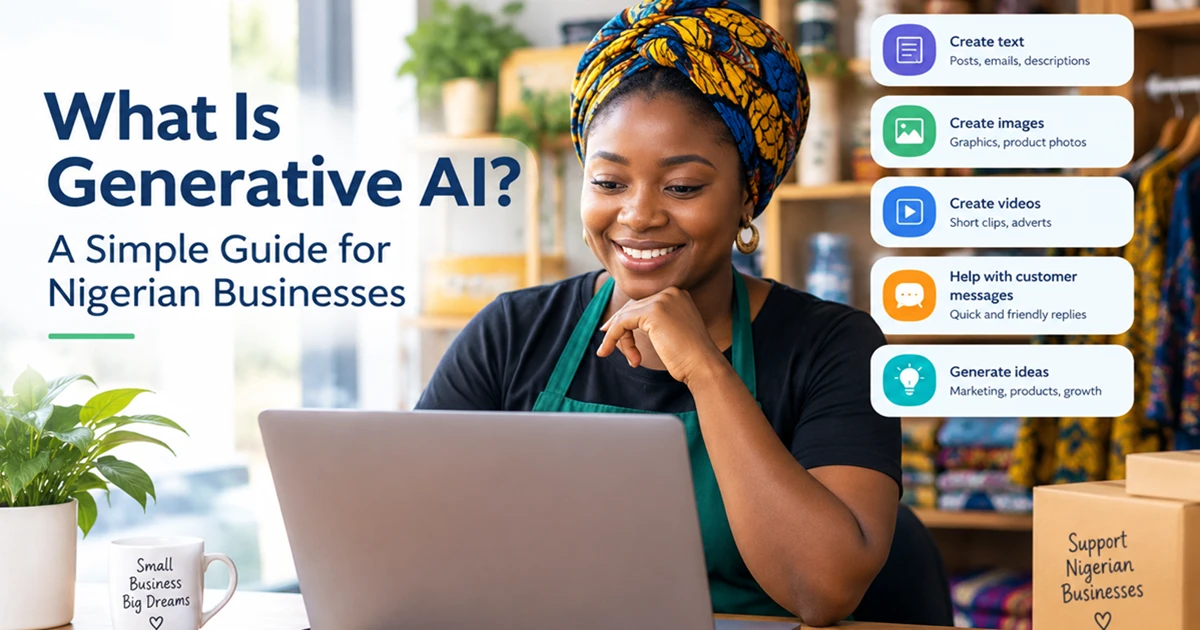
The Tool That’s Changing How Nigeria Hustles
If you’ve been on WhatsApp, Instagram, or X (formerly Twitter) in the past two years, you’ve probably seen it. Content that looks polished, professional, and expensive. The kind of branding that used to require a full creative team.
Here’s the truth: many Nigerian small businesses are creating that content with generative AI tools they access for free or a few thousand naira monthly. In fact, 70% of Nigeria’s online population already uses generative AI tools, well above the global average of 48%.
But what exactly is generative AI? And more importantly, what can it do for *your* business? Let’s break it down without the tech jargon.
What Generative AI Actually Is (In Plain Terms)
Generative AI is a type of artificial intelligence that creates new content (text, images, audio, video, or code) based on instructions you give it. Unlike traditional AI, which analyzes data or makes predictions, generative AI produces things.
Think of it this way:
Traditional AI: A fraud detection system that flags a suspicious transaction.
Generative AI: A tool that writes the customer service response explaining why the transaction was flagged.
The technology behind this is called machine learning. These AI models are trained on massive amounts of data, including text from books, articles, and websites, and they learn patterns in how language, images, and ideas fit together. When you give them a prompt, they generate a response based on what they’ve learned.
You’ve likely already encountered generative AI if you’ve used ChatGPT, Meta AI, or Canva’s design tools. These are the most common entry points for Nigerian businesses.
Why This Matters for Nigerian Businesses Right Now
Nigeria’s economy runs on small and medium enterprises. The informal sector employs roughly 92% of the workforce. For most of these businesses, hiring a dedicated marketing team, graphic designer, or content writer is simply not in the budget.
This is where generative AI changes the game.
A fashion designer in Lagos can use AI to create model images for their Instagram page without paying for a photoshoot. A food vendor in Imo State can generate product descriptions for online listings. A consultant in Abuja can draft proposals in minutes instead of hours.
The Nigerian government has recognized this potential. The National Artificial Intelligence Strategy (NAIS), launched in 2025, sets a five year vision to position Nigeria as a leader in ethical and inclusive AI innovation. With about 70% of Nigeria’s young workforce targeted for AI related skills training, the ecosystem is being built to support businesses that want to adopt these tools.
Real Nigerian Examples: How Businesses Are Using Generative AI Today
The Fashion Designer in Lagos
Olamilekan Oke runs a shoemaking brand called ‘Feeted’ from a modest workshop in Ojo, Lagos. He couldn’t afford professional models or photographers. Instead, he uses ChatGPT to generate images of models wearing his designs and Canva to create marketing graphics.
“These tools are very valuable to me,” he says. “My brand is not big enough to hire models and photographers, so ChatGPT creates models for me and saves me costs”.
The Agri-Food Entrepreneurs in Imo State
Through a program called IDEAS, supported by the International Trade Centre and Microsoft, small food producers in Imo State learned to use generative AI for product descriptions, social media posts, and buyer communications.
Ogechukwu Domendu, founder of Crème Bay Integrated Services, put it simply: “While we do not employ professional content creators, the simple to use digital tools allow us to present our products in a compelling way and engage potential customers”.
The Banks You Already Use
Nigeria’s biggest banks have invested heavily in AI. UBA’s chatbot Leo, launched in 2018, now serves over 6 million users across multiple platforms and languages. These are not experiments. They’re core parts of how these institutions serve customers.
What Generative AI Can Do for Your Business
Here are practical applications Nigerian businesses are already using:
Marketing and Content Creation
Generate social media captions, blog posts, email newsletters, and product descriptions. Tools like ChatGPT and Meta AI can write in Nigerian English, pidgin, or formal business language depending on your audience.
Visual Content
Create logos, social media graphics, product mockups, and model images without hiring designers or photographers.
Customer Communication
Draft responses to common inquiries, write follow up messages, and create templates for WhatsApp Business or email support.
Business Documents
Generate proposals, contracts, reports, and presentations. These tools can summarize lengthy documents and extract key points.
Idea Generation
Stuck on a product name? Need marketing angles? Want to brainstorm solutions to a business problem? Generative AI can generate options you might not have considered.
Important Considerations for Nigerian Businesses
Data Protection Is Not Optional
Nigeria has a robust data protection framework. The Nigeria Data Protection Act (NDPA) 2023 governs how personal data is collected, processed, and stored. If you’re using AI tools that process customer data such as names, phone numbers, or transaction details, you have legal obligations.
The Nigeria Data Protection Commission (NDPC) licenses Data Protection Compliance Organisations (DPCOs) that can help businesses conduct audits and implement compliant practices. For businesses processing data of 2,000 or more individuals annually, compliance audit reports must be submitted by March 15 each year.
Not Everything Needs AI
Generative AI is a tool, not a strategy. If your business doesn’t create content, communicate with customers digitally, or generate written materials, the immediate benefits may be limited. Start with your biggest pain point, likely marketing or customer communication, and expand from there.
Quality Still Requires Human Judgment
AI generated content can sound generic. The Nigerian marketing consultant Theophilus Alawonde noted that in emerging markets, “you can’t differentiate Arike empire from Ashake empire because the branding assets are the same”. The businesses getting the best results are using AI as a starting point, then adding their unique voice and brand personality.
Getting Started: A Simple Path for Nigerian SMEs
Start with free tools. ChatGPT, Meta AI, and Canva all offer free tiers that are more than sufficient for most small businesses.
Learn basic prompting. The quality of AI output depends heavily on the quality of your instructions. Be specific about what you want. If you’re describing a product, include details about your target customer, the tone you want, and the platform you’re posting on.
Test one use case at a time. Don’t try to transform everything at once. Pick one task, say Instagram captions or customer inquiry responses, and see how it goes for a month.
Stay compliant. If you’re processing customer data, familiarize yourself with the NDPA requirements. Free training resources are available through the NDPC.
Conclusion: A Tool Built for Nigeria’s Moment
Nigeria faces real economic challenges. But it also has a young, digitally savvy population, a thriving startup ecosystem, and government policies that actively support AI adoption.
Generative AI levels the playing field. It gives small businesses access to capabilities that were once reserved for companies with big budgets. The artisan in Lagos, the food producer in Imo, the consultant in Abuja. They all have access to the same tools that multinational corporations use.
The question isn’t whether generative AI will change Nigerian business. It already is. The question is whether you’ll use it to your advantage.
Have you used generative AI in your Nigerian business? What has worked, and what hasn’t? Share your experience in the comments.